


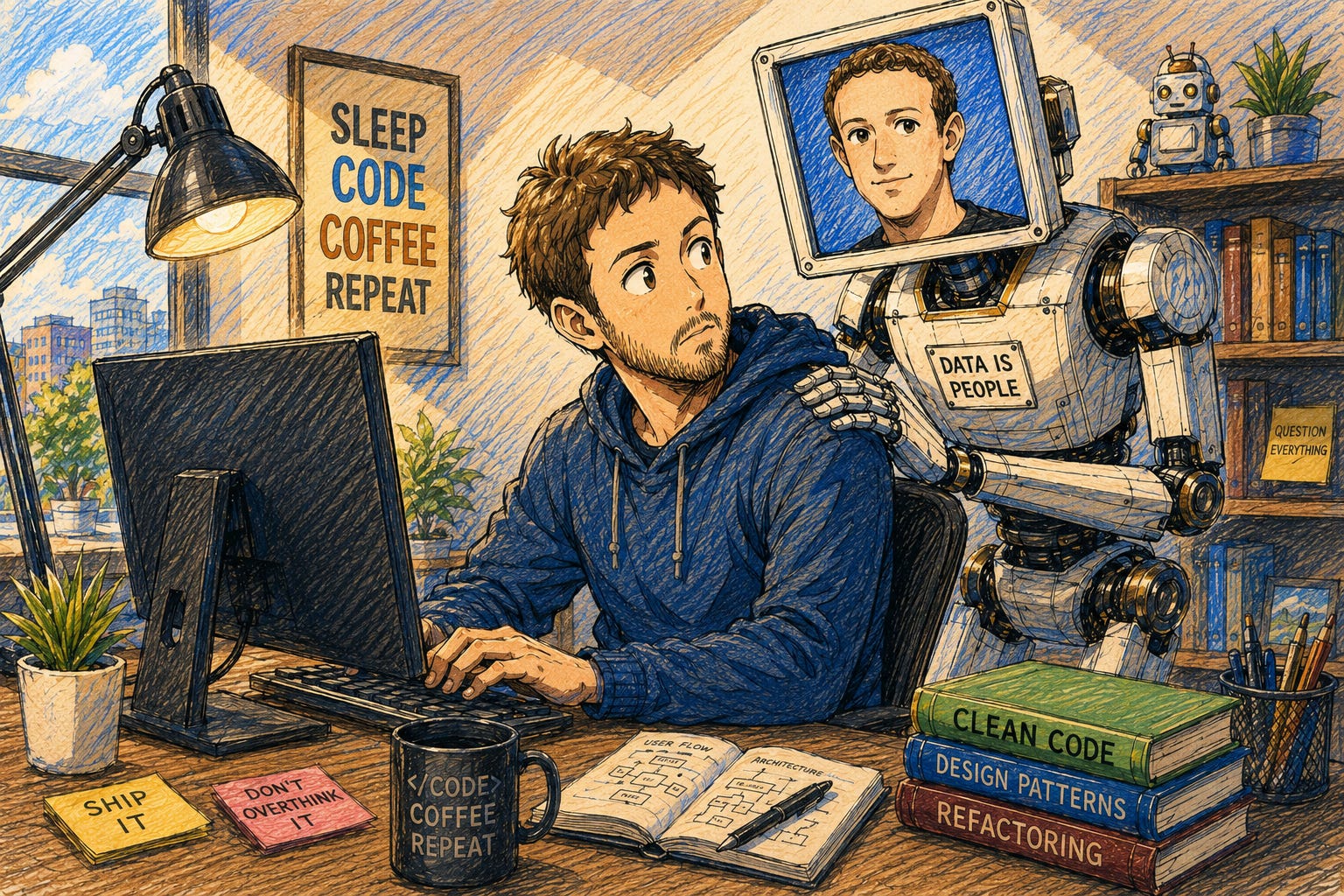
On April 30, in a Meta all-hands, Mark Zuckerberg explained why the company had quietly installed software on employees’ machines that captures their mouse movements, clicks, and keystrokes. The explanation leaked. Here’s the heart of it: the AI models learn from watching really smart people do things, and Meta’s people, he argued, are smarter than the contract workers the rest of the industry uses to train models. So watch the smart ones. Capture what they do. Feed it to the model.
Then, today, Meta is laying off roughly 8,000 people. About 10% of the company.
You don’t need a decoder ring. Watch the smart people. Train the model. Cut the smart people. Whether or not Zuckerberg would phrase it that baldly, the timing phrases it for him.
I want to be fair about what he actually claimed, because the real argument is narrower than the headline, and it falls apart for a more interesting reason than most people think.
What he actually said
Strip the surveillance optics off it and Zuckerberg’s literal point is about data quality. His case is that Meta’s own engineers are a higher-quality data source than the contractors most companies pay to generate training examples. He framed Meta’s AI work as three things: research and architecture, infrastructure, and data. The keystroke tool feeds the third one. He also said no humans are reviewing individual employee activity, and that none of this is about surveillance or performance.
Fine. Let’s grant all of it. Let’s say Meta’s engineers are the best demonstration data on the planet. Better than contractors, better than an open-source scrape, better than anything anyone else can get their hands on.
It still doesn’t do what he thinks it does. And I know that because I spend every working day doing the exact thing he’s trying to record.
The thing you can't capture
I run a small software company. I’m building a live scorekeeping and team management app for youth baseball and softball coaches, and I write code with AI tools constantly. Claude Code, WindSurf, the whole kit. I am not an AI skeptic. The acceleration is real and I’ll defend it to anyone.
But here’s what a year of building with these tools has burned into me: an AI watching me work would learn the wrong thing.
A few months back I moved my entire stack off Microsoft Azure and onto Hetzner, a much cheaper European host. Before I pulled the trigger, I asked the AI what it thought. It argued against the move. It listed all the enterprise-grade reasons to stay: the compliance posture, the certifications, the managed services, the whole HIPAA-and-SOC-2 security blanket.
And it was wrong. Not because its facts were wrong, but because it had no idea what I was building. I’m running an app for volunteer coaches standing in 95-degree heat trying to swap two kids in the batting order before the umpire yells “play ball.” The enterprise compliance overhead Azure was charging me for was overhead I would never, ever use. The AI couldn’t see that, because “what is this product actually for” is not something you can read off my screen. I overruled it. The migration was the right call. Costs dropped, nothing broke.
Now picture Meta’s keystroke recorder pointed at me during that migration. It would have logged every command I typed, every config file, every terminal session. And it would have learned absolutely nothing about the decision, because the decision happened in my head, built on context the recorder cannot reach. The recorder captures what I did. It cannot capture why I did it, or why the obvious answer was the wrong one.
That’s the whole ballgame. You can record the work. You cannot record the judgment. And judgment is the thing you are paying smart people for.
I get the same lesson inside the code itself. The AI is a phenomenal implementer. Once I hand it an architecture, it’ll execute that design across a dozen files faster than I ever could. But it has never once handed me the architecture. It can’t. When my app had a nasty bug born from a bad early design choice, the AI’s instinct was to slap a patch on the symptom. I had to stop it and redesign the whole pipeline, because I’m the one who knows how coaches actually use the thing, what breaks when the cell signal drops, what happens when a kid shows up late wearing the same jersey number as the starting pitcher. The AI built my fix beautifully. It would never have designed it. (I’ve told that whole war story elsewhere, so I’ll spare you the schema diagrams.)
Now multiply that by a company with tens of thousands of people
Here’s where Zuckerberg’s plan goes from flawed to genuinely silly.
My company is small. The context the AI can’t see lives in exactly one head: mine. Now scale that up to Meta, a company with thousands of moving parts, hundreds of interlocking systems, decisions stacked on decisions made by people who’ve been there a decade.
A model watching a senior engineer’s screen sees the edits. It does not see the three years of tribal knowledge that make those edits correct. It does not know why a particular service is built the weird way it’s built, because the “why” is a hallway conversation from 2021 that nobody wrote down. It does not know which of the company’s forty competing priorities actually matters this quarter.
Ask the practical questions and the whole thing collapses. Does the model know what to deploy, and when? Does it know which project should be split across two teams and which one should be killed outright? Does it know the right moment to optimize a slow piece of code, or, the harder question, whether you should optimize it at all, instead of leaving it ugly and shipping the feature that’s actually on fire? Does it know the politics, the dependencies, the one customer who walks if this slips?
Is a model going to replace the person at Meta who’s been there ten years, knows four different domains, manages a team of engineers, and carries the entire unwritten history of why things are the way they are inside their head? No. It is not. You can record that person’s screen for a thousand hours and capture none of what makes them valuable, because almost none of it is on the screen.
How do you even get that context? You don't. That's the point. It isn't a data problem you solve with a better recorder. It is not in the data at all.
Klarna already ran this experiment

This is not theoretical. Buried behind the noise of mainstream media and social networks, a company already did the full version of what Meta is flirting with, and it blew up in public.
Klarna, the Swedish “buy now, pay later” fintech, went all in. Starting in 2023 it replaced around 700 customer service workers with an OpenAI-powered assistant, froze hiring, and let its headcount fall by roughly 40%, from about 6,500 to 3,800. For a while the numbers looked incredible. The bot was handling two-thirds of all customer chats. CEO Sebastian Siemiatkowski was on every stage telling the world the future had arrived.
Then the future arrived. Service quality fell. Customers got frustrated. And by 2025 Siemiatkowski was admitting, out loud, that the company had gone too far, that the all-AI approach produced "lower quality" service, and that Klarna would start hiring humans back so customers always had the option to reach a real person. By 2026 the Klarna saga has become the canonical cautionary tale that executives now get asked to explain their way around. The research backs it up: one Orgvue/Forrester survey found that 55% of companies that rushed to replace workers with AI already regret it, because the savings on paper turned into churn, reputation damage, and the cost of unwinding the whole mess.
And here's the part Meta should sit with. Klarna was automating tier-one customer service. Routine, high-volume, mostly scripted work. Genuinely one of the easier things to automate, and it still got burned. Meta isn't pointing the recorder at tier-one anything. It's pointing it at the hardest, highest-judgment work in the building, the engineering, and betting it can capture that. If Klarna couldn't replace the easy stuff, what exactly makes Zuckerberg think he can replace the hard stuff?
IBM did it right, and it proves the point
The cleanest counterexample comes from a company nobody would call AI-shy: IBM.
IBM also used AI to replace people. CEO Arvind Krishna said the company automated a couple hundred HR roles with an AI agent that now handles roughly 94% of routine HR tasks: pay statements, vacation requests, the paperwork. So far it sounds exactly like Meta.
Except IBM’s total headcount went up, not down. The money saved on the rote work got plowed into hiring more software engineers, salespeople, and marketers. Krishna drew the line himself, and it’s the line that matters: AI took over the “rote process work,” and IBM reinvested the savings into roles built on critical thinking, the jobs where people, in his words, “face up or against other humans.”
Read that next to what Meta is doing and the contrast is brutal. IBM automated the rote and grew the judgment. Meta is trying to harvest the judgment and cut the people who have it. One company used AI to delete the boring part of the job. The other is using it to try to delete the part that was never boring, and never recordable.
That’s exactly the split I see from where I sit. As a one-man shop, AI is a gift, precisely because it erases the tedious work I’d otherwise drown in: the boilerplate, the layout tweaks, the mechanical bug fixes. That’s the IBM move, scaled down to one guy with a laptop and a Substack. But the giants like Meta have something different. Their entire value is locked up in human context, and they’re aiming AI at the one asset that can’t be rebuilt from a log file.
The part that makes it genuinely dumb
Take Zuckerberg’s own premise seriously for one more second. If the models learn by watching smart people make smart decisions, then the smart people making smart decisions are the supply. They are the well. Every novel call a senior engineer makes today is potential training data for tomorrow.
So what happens when you fire them?
You freeze the model at yesterday’s ceiling. A model trained on the decisions of 2026 can imitate the decisions of 2026. It cannot make the right call on a problem that doesn’t exist yet, because the context that drives that call, the new product, the new constraint, the new mess, was never in the data. New problems demand new judgment, and new judgment comes from humans sitting in the new mess. Cut the humans and you stop refilling the well. You are eating your seed corn and calling it a harvest.
You cannot watch your way to a model that replaces the people you’re watching, because the moment they’re gone, there’s nobody left generating the thing you were copying.
Why this earns backlash, not applause
One last thing, and it’s the thing the spreadsheet never shows.
Smart engineers are not Excel users. They talk. They have options. They read the room. When you install software to record their keystrokes and then, weeks later, lay off 8,000 of their colleagues, the message lands with perfect clarity: we are studying you so we can need fewer of you. That is not a message that makes your best people work harder. It makes your best people, the exact ones with context worth capturing and résumés worth shopping, leave first.
And we know they talk, because this entire story exists thanks to a leaked all-hands. You cannot quietly turn your workforce into training data. They notice. The market notices too. Klarna found out that customers can tell, and they walk. Meta is about to find out that engineers can tell, and they walk faster, and they take the context with them.
Dear Mark
You can record the work. You can’t record the judgment.
The keystrokes, the diffs, the clicks, all the stuff your software is busy capturing, that’s the visible layer. It’s the easy 10%. The other 90%, the part that decides whether the work was even right, lives in context the recorder will never reach: the why, the history, the customer, the call somebody makes at 11 PM because they actually understand the thing they built. That is what your smart people are for. That is the entire job.
Klarna learned it and reversed. IBM understood it from the start and grew. You’re on track to learn it the expensive way: 8,000 people carrying context out the door, and a model that got really, really good at imitating a version of your company that no longer exists.
The context is the job, Mark. And the day you fire the people who have it, you’ve capped your AI at the past.
The story everyone is getting wrong
One last point, and it’s bigger than Meta.
Credit where it’s due: More Perfect Union did real work dragging this leak into the light. Watching a billionaire explain, on tape, that he’s recording his own staff to train their replacements is exactly the kind of thing the public should see.
But scroll the comments under that clip, on any platform, and you’ll find the same verdict copy-pasted ten thousand times: “AI is going to replace us all.” That’s the conclusion people are taking away from it. And it’s wrong. Not naive, not Pollyanna. Just wrong, and the data says so.
Let me be straight, though, because the doomers aren’t hallucinating, and pretending they are is how you lose the argument. People are losing jobs. Meta cut 8,000 today. The entry-level software market is genuinely brutal right now: recent computer science grads are sitting around 6% unemployment, higher than philosophy or art history majors, and entry-level engineering postings have fallen off a cliff since 2023, with Stanford’s Digital Economy Lab putting the drop near 67%. New grads now make up a shrinking sliver of big-tech hiring. If you’re 22 with a fresh CS degree refreshing a job board, the fear is rational. I’m not going to tell you nobody’s being displaced.
I’m going to tell you the conclusion is backwards.
Because look at the same labor market one rung up. The Bureau of Labor Statistics projects software developer employment to grow 15% between 2024 and 2034, five times the average for every other occupation, with roughly 129,000 openings a year and median pay north of $130,000. And the BLS lists AI as one of the drivers of that growth, not a threat to it. The head of Code.org said it cleanly: AI isn’t killing computer science, it’s making it more essential.
Both things are true at the same time, and that’s the part nobody bothers to explain. The floor is collapsing while the ceiling keeps rising. AI is eating exactly the work I described earlier, the rote, the boilerplate, the mechanical first draft, which happens to be the work juniors used to cut their teeth on. What it is not touching is the judgment layer, which is why demand for experienced engineers keeps climbing even as the junior on-ramp narrows.
Which means the whole industry is doing, at scale, the same dumb thing Meta is doing in miniature. By automating away the bottom rung, we’re starving the pipeline that turns juniors into the senior engineers everyone agrees we’ll need more of. Same seed corn, bigger field.
That’s the story the media should be telling, and mostly isn’t, because “Zuckerberg surveils his own engineers” is a better headline than “here’s how to actually position yourself for the next decade.” The dunk gets the clicks. The useful version, the one that tells a scared 20-year-old that the opportunity is bigger than ever but the door moved, gets buried under outrage.
So here’s the useful version, plainly. If you’re steering away from tech because you think AI is going to take the job, you’ve got it backwards. The job isn’t going away. It’s moving up the stack, toward context, judgment, and decisions, the exact things this entire essay just spent two thousand words proving AI can’t do. The kids running to the trades aren’t wrong that the trades are durable and AI-resistant. They are. But running away from tech out of fear of replacement is solving the wrong problem.
The replacement was never coming for the people who can think. It was only ever coming for the typing.
Sources: the leaked April 30 Meta all-hands as reported by The Week, India Today, and Investing.com, and surfaced by More Perfect Union; Meta’s May 20 layoffs (roughly 8,000 jobs, about 10% of staff); Klarna’s reversal via Bloomberg, Business Insider, CX Dive, and Siemiatkowski’s own public comments; the 55% regret figure via Orgvue/Forrester research; IBM’s HR automation and headcount figures via The Wall Street Journal and Arvind Krishna’s public statements; software developer growth projections, openings, and median pay via the U.S. Bureau of Labor Statistics; entry-level and recent-graduate figures via the Federal Reserve Bank of New York, Stanford’s Digital Economy Lab, and SignalFire; the Code.org comment via Fortune.
To me this suggests Meta sees parts of human work as data to be extracted and modeled, which can feel like reducing people to datapoints.
And true this raises the concern that human behavior is being treated as training material rather than something with its own dignity and context.
Interesting timing to find this article, i just said to chatgpt that its weakness is lacking (as absence) of the indirect context that wasn’t included into my problem’s description. Especially when a problem to be evaluated is a niche problem with combined context built through details accumulated as a result of previous dialogue. Record clicks will not help to make ai to pay attention to things not explicitly stated. A human can do it.