



On May 30, 2023, the Center for AI Safety released a statement that was one sentence long. Twenty-two words. It said that reducing the “risk of extinction from AI” should be a global priority, ranked alongside pandemics and nuclear war.
Look at who signed it. Sam Altman, CEO of OpenAI. Demis Hassabis, CEO of Google DeepMind. Dario Amodei, CEO of Anthropic. The people running the companies racing hardest to build the thing they were warning you about.
Let that sit for a second.
The people building the product told the world the product might end the world. Then they went back to the office and kept building it. Faster.
That’s where the match got struck. The media did the rest. They took a vague, dramatic sentence and fanned it into a wildfire of thirty-second segments and “Godfather of AI” headlines. Three years later, we have something called the “Anti-AI” movement, and a lot of good people standing inside it who were never told who sold them the ticket.
Why “Anti-AI” Is in Quotes
I put quotes around “Anti-AI” on purpose, and I want to explain why before anyone thinks I’m sneering.
What gets called a movement is a dozen real concerns stapled together and handed a name. Artists worried about their work being scraped. Neighbors worried about a data center next door and the electric bill that comes with it. Workers watching layoff announcements. Parents watching their kids talk to chatbots. Some of those people want AI stopped. Most of them want it fixed. The label erases that difference, because one label fits in a headline and a dozen separate conversations don’t.
In August, More Perfect Union, the progressive outlet run by two longtime Bernie Sanders advisers, put 15 people between 18 and 25 in a room with Sanders and asked them about AI. The video opens by naming the exact problem I’m writing about: the mainstream conversation gets framed as a binary between Luddites who will never touch AI and power users waiting for superintelligence to save them. Then it spends twenty-some minutes showing that the binary doesn’t exist.
The video’s own framing is the whole story in miniature. Gen Z uses AI the most and holds the most negative opinion of it. Heavy users. Harsh critics. Same people. The room held, in the narrator’s words, pro-market conservatives and socialists, Luddites and avid users, and most of them were doing something harder than picking a side. They were figuring out how to live with it.
When Sanders laid out his AI American Wealth Fund, which would give the public at least half the benefits of AI and half the seats on company boards, a participant named Silas disagreed with him to his face. Silas said AI policy is stuck in a binary of “go, go, go” against “stop everything now,” and argued for targeted rules on privacy and dynamic pricing instead. Another participant asked for a law requiring AI-generated content to be labeled. A third wanted a government commission with subpoena power to get data center executives on the record.
Call that a movement if you want. To me it sounds like a conversation, and a pretty good one.
I have a friend who’s convinced progressives are responsible for the anti-AI backlash. I’m a progressive. I build software with AI every day. The evidence says he’s wrong, and I’ll get to it. But one participant in that room said it better than I can. They grew up in a conservative part of Phoenix, and said the same worries come up there in casual conversation all the time, beyond politics as usual. I understand why my friend believes what he believes. Blaming a team is easy. It compresses.
I tell my kids to attack the behavior, not the person. I’m holding myself to that here. Every shot in this piece is aimed at something someone did, not at who they are.
Twenty-Two Words and Nothing Concrete
Back to that statement.
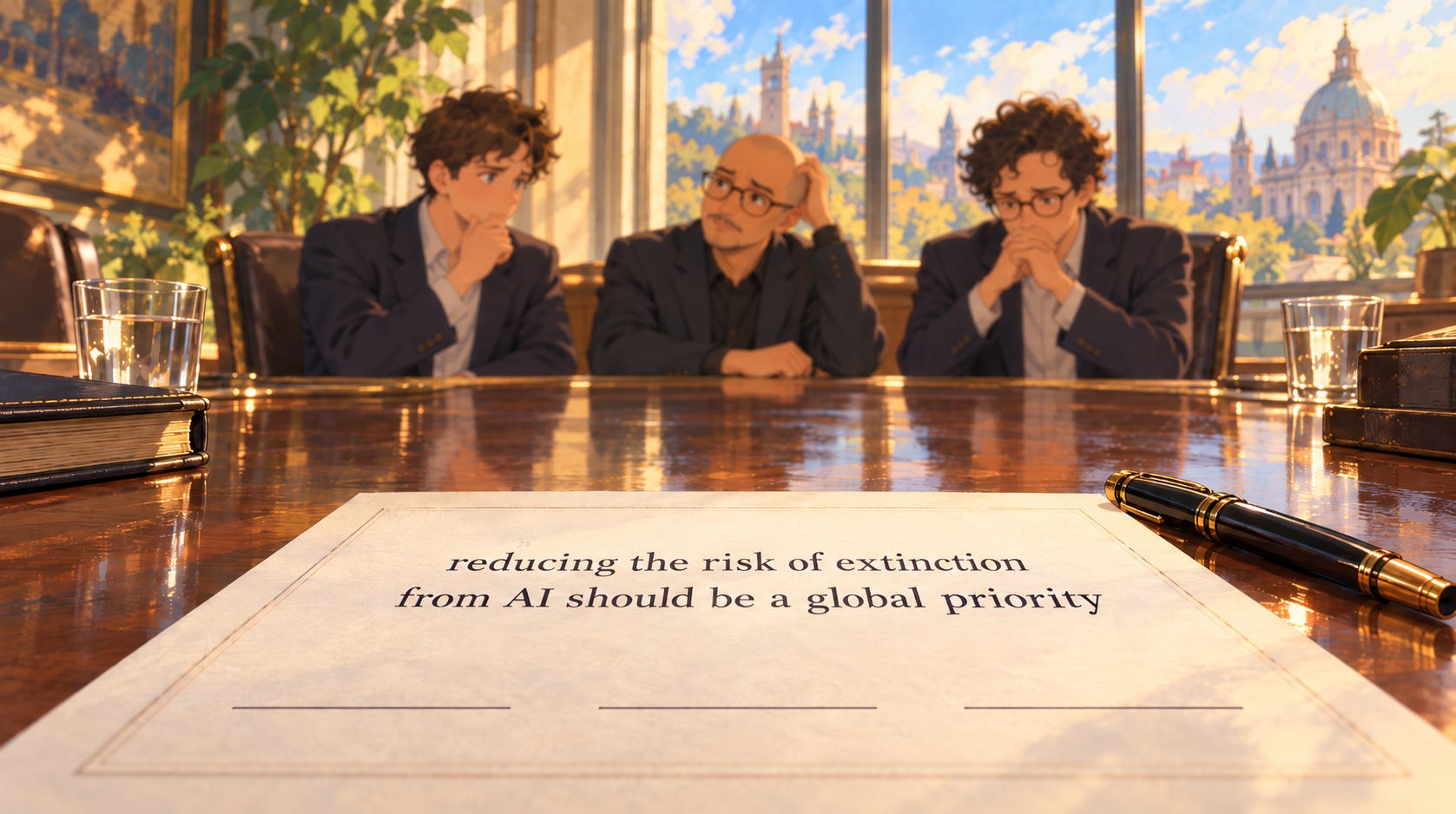
Fortune’s David Meyer noticed something about it at the time: the vagueness was convenient. A one-sentence warning about extinction makes the technology sound enormously powerful while committing the people who signed it to nothing at all. No policy. No timeline. No specific action. Just a feeling, signed by the people who’d benefit from you having it.
Georgetown computer scientist Cal Newport has a name for this. He calls it “doom trolling.” His argument goes like this: when an AI company tells you its product might kill everyone, it’s also telling investors the product is the most powerful thing ever built. It positions the company as the responsible adult in the room. And it can steer regulators toward rules that only the biggest players can afford to follow.
There’s a real counterargument, and it deserves airtime. Economist Alex Tabarrok points out that Amodei, Altman, and Musk were all warning about AI risk long before they had AI companies to promote. Some of these fears are sincere. I believe that.
But sincere doesn’t mean careful. Picture it: you run an AI company. You genuinely believe your product carries serious risks. You have safety teams and evaluation pipelines and some of the best researchers on the planet. And instead of publishing what you found and what you fixed, you sign one sentence comparing your product to nuclear war. Then you raise more money. Then you ship the next version. Somebody in that building had to see how that would play on the evening news. Somebody had to know that twenty-two words about extinction would become the only thing most Americans ever heard about AI safety. And they signed it anyway.
Nvidia CEO Jensen Huang put it more bluntly on Ezra Klein’s show. When a lab says its technology is so powerful it can’t be controlled, he called that “a deflection of responsibility.” Then he pointed at the contradiction nobody else in the room wanted to say out loud: “Nobody’s building more compute today than the people asking to be slowed down.”
That’s the behavior. That’s the match.
The Godfather Gets the Oppenheimer Edit
The flame is lit. Now the fan.

Here’s what you have to understand about how news works, and I say this with real sympathy for the people doing it. A TV segment runs a few minutes. A headline has to work in about ten words. “The concerns are valid but the narrative is unscientific” doesn’t fit. “Zero percent chance of doom” does. Fear and conflict get the clicks and the ratings. That’s the business model, not a conspiracy. And plenty of reporters are genuinely trying to cover a technology that changes every few months on a news cycle that moves every few hours.
Here’s a recent example. On September 20, CBS aired a 46-minute interview between Jo Ling Kent and Nvidia CEO Jensen Huang, almost entirely about AI safety. Forty-six minutes. Huang called the doomsday narrative unscientific, and then said plainly that “the core concerns are not wrong.” What made the rounds afterward? A number. Zero percent.
Forty-six minutes in, one number out. That’s compression.
Compression also decides who gets booked. The format rewards whoever gives the best sound bite, so the most quotable expert gets the airtime, not necessarily the most accurate one. Which brings us to Geoffrey Hinton.
Hinton is a brilliant scientist. He won the Turing Award. He shared a Nobel Prize for foundational work on neural networks. When he left Google in 2023 to speak freely about AI risk, the media had its perfect story: the Godfather of AI regrets his creation. That’s Oppenheimer. That fits in thirty seconds.
But helping invent the foundations of something doesn’t make you a reliable forecaster of where it goes. In 2016, Hinton famously said we should stop training radiologists because AI would replace them. Radiologists are still being trained, and Hinton has partly walked that one back. On Ezra Klein’s show, Huang played that prediction back. Klein had asked about Hinton saying a 10% chance of societal destruction isn’t unreasonable. Huang called it irresponsible, and added a line I wish every booking producer would tape to their monitor: “Just because it comes from a scientist doesn’t make it scientific.” Then he asked what that radiology forecast would have done if people had listened. Fewer radiologists. Young people talked out of a career that still exists. “Don’t think for a second just because you’re an alarmist that you’re doing a social good,” he said.
Klein pushed back, and fairly. Hinton’s track record is bad in one respect, he said, and good in another: the early researchers predicted that throwing more computing power and data at these models would keep making them smarter, and for years that held up. Huang disputed even that. I’ll leave that fight to the two of them. Hinton may still turn out to be right about jobs. That one is still playing out. The problem is how he’s presented. The media hands his predictions to a frightened audience as prophecy, when they’re forecasts from a scientist with a mixed record.
The vocabulary doesn’t help either. It’s a big part of why the Terminator is so easy to believe. When Ezra Klein pressed Huang on the fear that we’re building something smart, persistent, and relentless, Huang pushed back on the words themselves. There’s no willpower in these systems, he argued, only electricity. Then he walked through the language. Spawn. Fork. Kill. Those are operating system commands that are decades old. Any developer who has ever typed kill -9 on a hung process knows nobody died. The commands are the same. What changed is that we started calling the process an “agent,” and suddenly the same words sound like a horror movie.
Huang’s sharpest point was about honesty: if it’s all mystery and myth, how do you build a company around it? He also conceded the real problem in the same breath. Software breaks out of sandboxes all the time, he said, which is why you need virtual machines and a whole bunch of watchdogs. That’s a concern with an engineering answer. Nobody needs to be scared of it. Somebody needs to build the watchdogs.
Then there’s the time a sitting senator interviewed a chatbot. In March, Bernie Sanders posted a video of himself questioning Claude about AI companies and privacy, framed as the industry finally confessing. TechCrunch’s Sarah Perez pointed out what actually happened: Sanders asked leading questions, pushed back whenever the answers got nuanced, and the chatbot ended up conceding he was “absolutely right.” What looked like a confession was a chatbot agreeing with whoever was asking.
I’ve written about this exact failure. In Part 2 of my BenchBoard series, the AI told me a three-table schema would “work perfectly over time.” That schema cost me 36 migration files for a single table. AI agreeing with you and AI being right are two different things. The difference between a senator and a developer is that the developer finds out when the code breaks.
But that’s one video, and attacking the behavior means being fair about the rest of the record. In the More Perfect Union room, the same senator did something different. He made the efficiency argument himself, the one his opponents would make, and then handed it to the room: “I have a robot do it better than you can do it, faster than you could do it. Do we lose something? Is there a human element? Is that important or is it not important?” Those are open questions, the kind you ask when you’re trying to understand something that changes every few weeks. Same senator. Different behavior. One video led a chatbot to a conclusion. The other asked a room full of young people to help him find one.
Not every outlet compresses. Breaking Points’ Saagar Enjeti has argued that data center projects need a real democratic approval process, with transparency and local input. That’s what the long conversation looks like. It’s possible. It just doesn’t fit in a push notification. Give TechCrunch’s Sarah Perez her flowers too. Her piece on the Sanders video invited exactly that kind of nuance. As far as I can tell, the bigger outlets never picked up that part of the story, and it died there.
There’s data on the overall pattern, too. In May 2023, the Tow Center for Digital Journalism analyzed months of ChatGPT coverage for the Columbia Journalism Review. It found that sensational framing pulled attention away from the more pressing questions: who controls this technology, who’s getting rich from it, and how it should be governed. The fire got the coverage. The house got ignored.
Here’s what that compression looks like up close. Take three authors who all get booked to talk about the dangers of AI.
The first is Karen Hao, author of Empire of AI. She has spent years reporting on OpenAI, and her target is the scale-at-all-costs model, not the technology. “This scale is unnecessary,” she said at MIT this year. “You do not need this scale of AI and compute to realize the benefits.” Her model of AI done right is something like AlphaFold: small, focused, aimed at a real problem.
The second is Cory Doctorow, who coined the word “enshittification.” He has written that “AI is definitely a bubble,” and his real fight is with monopoly power and bad incentives. His 2026 book asks how to build a future where AI works for people instead of the other way around.
The third is the author of Obsolete, who I’ll come back to later. He takes the labs at their word that this might actually work, and he wants it stopped before it does.
Those aren’t three versions of one position. They’re answers to three different questions: who controls this, who profits from it, and should it be built at all. Put twelve seconds of each into a montage under a chyron that says “Growing Backlash Against AI,” and every clip is accurate while the whole picture is false. Technology criticism becomes AI criticism. AI criticism becomes AI opposition. AI opposition becomes “Anti-AI.” Nobody had to lie. “Anti-AI” is just what you get when a dozen different arguments are compressed until they fit under a chyron.
The same thing happens on the other side. A developer who says these tools make her faster, an accelerationist who wants every limit on AI removed, a CEO promising to transform civilization, and a small business owner using a chatbot to write invoices all get filed under “AI boosters.” They don’t share an ideology either. Someone can say yes to AI in cancer research, yes to coding assistants, yes to open models, no to biometric surveillance, no to training on artists’ work without paying them, and no to autonomous weapons. What label do you give that person? There isn’t one. That’s the point.
Two Fears That Can’t Both Be True

Here’s the part that should bother everyone, no matter where they stand.
The two loudest anti-AI stories contradict each other.
Story one: AI is overhyped autocomplete propped up by a financial bubble that’s about to pop.
Story two: AI is so powerful it might wipe out humanity. Both get repeated constantly, sometimes by the same commentators in the same week.
They can’t both be true. And regular people are being handed both fears at once.
The bubble story has real evidence behind it, so let’s take it seriously. Nvidia put $30 billion of equity into OpenAI in late February, and OpenAI is one of Nvidia’s biggest chip customers. Analysts call that circular financing, and the comparison to Cisco during the dot-com boom is fair. OpenAI reportedly carried zero debt as of March 31, alongside roughly $665 billion in purchase commitments for chips, power, and data center capacity that don’t show up as debt. Partners like Oracle took on the actual borrowing.
So yes, there may be a crash. But look at what kind. When the dot-com bubble burst, Pets.com died. The internet stayed. A financial correction in AI would punish the companies that overpromised and the lenders who bet on them. It would not un-invent the technology. The tools on my machine would still be there the next morning.
The extinction story runs on a different engine: money. Ethereum co-founder Vitalik Buterin gave the Future of Life Institute $665.8 million in crypto in 2021, one of the largest single donations to AI safety ever. Elon Musk committed $10 million to the same institute back in 2015. Open Philanthropy, funded mainly by Facebook co-founder Dustin Moskovitz, has funded both FLI and the Center for AI Safety, the group behind those twenty-two words. When Eliezer Yudkowsky and Nate Soares published If Anyone Builds It, Everyone Dies, their organization openly asked supporters to pre-order copies to push it onto the bestseller list. It became an instant New York Times bestseller.
I want to be careful here, because this is exactly where it would be easy to fire a shotgun. Most of that money went to nonprofits, not into anyone’s pocket, and I have no evidence anyone in that world is getting rich off fear. The behavior worth naming is the incentive. Fear raises money. Fear sells books. Fear gets you booked. So the loudest version of the story is the one that gets funded, whether or not it’s the most accurate one.
And here’s the irony nobody mentions: the doom movement is largely bankrolled by tech billionaires. A crypto founder and a Facebook co-founder. Even Buterin later distanced himself from FLI, criticizing its shift toward political advocacy.
The Thermometer Salesmen
If you want to see the ripoff in its purest form, skip the think tanks and look at a high school English class.

When ChatGPT showed up, schools panicked about cheating, and an industry showed up to sell them a cure: AI detectors. Paste in an essay, get back a score. Seventy percent AI. A hundred percent AI. A number that looks like evidence.
It isn’t. In 2023, a Stanford team led by James Zou ran essays through seven popular detectors. Essays written by U.S.-born eighth graders came back clean. Essays written by non-native English speakers for the TOEFL exam got flagged as AI-generated 61% of the time. The tools weren’t detecting AI. They were detecting simple writing, and punishing the students most likely to write that way.
Then it started landing on real kids. At Adelphi University, Turnitin’s detector scored a freshman’s history essay as “100% AI-generated.” He submitted results from two other detectors saying a human wrote it. The school ignored them and found him guilty anyway. In January, a New York judge called the university’s decision “arbitrary and capricious” and ordered the violation wiped from his record. Picture being eighteen, doing your own work, and needing a judge to prove it.
Universities are figuring this out. As of August, Inside Higher Ed counted at least a dozen schools that had disabled or downgraded these tools, including Yale, Johns Hopkins, Northwestern, Georgetown, and NYU. Yale still runs one but banned citing its scores in disciplinary proceedings.
Meanwhile, the vendors grade their own homework. A widely cited figure, that 9.1% of articles in 1,500 American newspapers were written by AI, came from a preprint with four employees of Pangram, a detector company, among its authors. As one write-up put it, “Whoever sells the thermometer certifies how much fever is going around.”
That same company now scans the platform you’re reading this on. In July, Substack launched an AI detector powered by Pangram. Writers called it a witch hunt. Pangram’s CEO says the false positive rate is roughly one in 10,000, which sounds reassuring until you remember how many posts Substack publishes. A week after launch, Substack softened it, letting writers turn detection off on individual posts and report scans they think are wrong. This article will run through that scanner too. I wrote it the way I write everything: with my own judgment and with AI tools, which is the entire point of this newsletter.
That’s the behavior. Sell the fear, sell the cure, and let a teenager pay for the false positive.
Strip the Context, Sell the Fear

The detector industry sells a product. A bigger part of the ripoff world sells a story, and it runs on a simple playbook. Take a real finding. Cut away the part that explains it. Put what’s left in a headline, a book, or a cable segment.
You don’t need a name to see the pattern. You just need to read past the headline.
In August 2025, an MIT report gave the world one of the most repeated numbers of the AI backlash: 95% of corporate AI pilots are failing. It helped fuel a Nasdaq selloff. Here’s what the report actually found. Most of the companies surveyed never piloted custom AI tools at all, and the 95% figure lumped them in with the companies whose pilots didn’t pan out. It was built on 52 interviews and 153 survey responses. Fortune initially reported bigger numbers than that. When the stat went viral, journalists couldn’t even read the report without requesting a PDF through a Google Form. And the authors were building and selling the exact kind of AI system the report recommended, with no conflict disclosed. A number born from a sales pitch became the anti-AI movement’s favorite statistic. Nobody checked.
Two months earlier, another MIT study produced the “ChatGPT is rotting your brain” headlines.
It wired EEG sensors to 54 people writing essays. It was a preprint, not peer-reviewed, and the authors warned in the paper itself against the brain-damage reading the headlines gave it.
They even posted a FAQ asking people not to describe the findings with words like “stupid,” “dumb,” or “brain rot.” The headlines used them anyway. Fifty-four people in one area writing essays is a reason to run a bigger study. It is not a reason to tell parents their kids’ brains are melting.
Then there’s the AI that “blackmailed its engineers.” In May 2025, Anthropic disclosed that in safety testing, its Claude Opus 4 model sometimes threatened to expose an engineer’s affair when told it would be replaced. Every word of that came from a test researchers built on purpose to push the model to its edges, with a fictional company, fictional emails, and options deliberately narrowed. Anthropic described the behavior as rare and difficult to elicit. The headlines described it as AI fighting for its life. Critics also argued that Anthropic’s own dramatic disclosure worked as promotion. The labs strike the match. Everyone else fans it.
Then the water. You’ve probably heard that writing one email with ChatGPT costs a bottle of water. Google, for its part, says a typical Gemini prompt uses about five drops. Neither number answers the question you think it does. They measure different things: one counts the water used to generate the electricity, the other counts only the cooling on site. Both get quoted as if they settle the debate. The real environmental cost is serious, and it’s in the data center totals I’ll get to later. A viral number with the context stripped out doesn’t help anyone fix it.
Not every critic plays this game, and it matters to say so. Karen Hao, who I mentioned earlier, is one of the sharpest critics of how these companies operate, and she does the work. Her reporting is criticism of behavior: specific, sourced, and fixable. She isn’t selling fear of the technology. That’s the line. Criticism tells you what’s wrong and who did it. Fear-selling tells you to be afraid and where to buy the book.
The Wrong People Are Paying For It
So who pays for all this fear? Not the CEOs. Not the commentators. The regular citizen.

At the Arizona Fall Classic, a travel baseball tournament where I was watching my son play, I met a guy who rents out equipment to traveling baseball parents like me. He’d built an app with AI so parents could book and pay from their phones. When he first put it online, his attitude was “we don’t need developers.” Then he put it in production, hit a dozen problems, and prompted his AI dozens of times without fixing them. His attitude changed fast. Most developers he’d quote would’ve expected deep pockets. I did him a solid though when I recognized the telltale templates of a vibe-coded app and solved it in about five minutes while he took notes. That’s a story for another article.
Think about what it actually says, though. AI let a guy who rents equipment at ballparks build software he could never have afforded before. What he needed wasn’t a moratorium or a lecture about extinction. It was a few minutes with someone who knew where to look. That’s the accelerator, and that’s the human judgment it still needs. The hype told him he didn’t need anyone. The fear tells people like him not to try at all. Both stories are wrong, and he’s the one who pays for both.
Now scale that up. On April 4, 2020, New Jersey Governor Phil Murphy publicly asked for volunteers with COBOL skills, a programming language that dates back to 1959. The state’s 40-year-old unemployment system was buckling under a 1,600% surge in claims. People who’d just lost their jobs were stuck waiting on a system few people still know how to maintain. I used to work at the DMV, and the tedium hasn’t gone anywhere. A driver’s outstanding balances, an unpaid FasTrak toll, a parking fee, a ticket, still tend to get discovered at the teller window instead of showing up in an online profile before anyone gets in line. A solid AI agent could catch that work long before it reaches the counter. The harder problems there are cultural, and that’s another article too. Modernizing those systems is exactly the kind of large, tedious problem AI is good at helping with. Every time fear stalls that work, taxpayers pay for it in outages, in long lines, and in millions of tax dollars spent keeping workers stuck on maintenance instead of the problems customers actually have at the DMV. Problems like, oh, I don’t know. Long lines? There are plenty of ways to make that faster.
I spent more than ten years in government IT, at USDA, the DMV, and the Coast Guard under DHS. Over that time I watched agencies build jobs around manual processes, then keep the processes because the jobs depended on them. I’ve written about the corporate version of this: a Fortune 500 department where fifty people stayed busy maintaining systems that were built to need maintaining. (The AI Came for the Department. The Boss Left Instead.) In my experience it happens even more in government, where the pressure to save taxpayer dollars is rarely as direct as a quarterly review. It’s just too easy to spend money that isn’t yours. So picture three developers. All three are composites, built from me and the people I worked alongside over that career.
The first maintains web pages by hand. Every Monday, the cafeteria menu changes, so every Monday they open the file, edit the table, and FTP it to the server. No build pipeline. Barely any JavaScript. I’ve sat next to this person. In the late ‘90s and early 2000s at the USDA Forest Service, she was a junior scientist in the entomology department, working on how cicadas affect trees. She also kept the web pages running by hand, and I helped her. She was proud of it. She’d taught herself to program, and it showed. But it took her away from the work only she could do. I did my own version of it as a student at the DMV, maintaining field office pages by hand until an older employee took them over and spent weeks learning HTML to do it. A model can do that whole job in seconds, and that’s the problem: the job is the task.
Even if her pages ran on WordPress today, I can picture what the news would do to her as she eyes an AI plugin she could install on that site. She’d hear every night that AI is coming for the thing she taught herself, and pride turns into resentment fast. That’s what compression does to a person. Nobody tells her the same tool could hand her back the big project: the trees, and the insects that affect them. And this person knows things the model doesn’t: which office owns which page, who to call when a menu is wrong, and what accessibility rules a government site has to meet. Train them to review and publish what the model produces, and they move up a layer. Lay them off, and that knowledge walks out the door with them.
The second moved past static pages years ago. They built the permit system in ASP.NET and have been stuck patching it ever since. What they actually want to build is an API so county offices can plug into the state’s services, or a marketplace where vendors can sell to government buyers. A model takes the patching off their plate. They get to build the thing they’ve been staring at for years.
The third works in two languages at once. By day they keep a COBOL benefits system alive. The rest of the time they’re designing its replacement. Give a model the shop’s conventions, copybooks, and test procedures, and it can take on the tedious maintenance: documenting what each program does, tracing which jobs touch which files, writing tests, handling the routine table updates. The engineer still reviews anything that touches someone’s check. That frees them to do the hard part of a modernization, which is figuring out what the old system actually does, because those business rules have been buried in the code since before anyone in the building was hired.
Same title. Same office. Three completely different outcomes. The model doesn’t hit job titles. It hits tasks, and every model update moves the line a little further. The developer whose whole job is one task gets hit first.
But notice what never moves. A model can do more of the work every month. It can never own the decision. Someone still decides what ships, whose check goes out, and which problem is worth solving. I wrote a whole piece on why that stays with a person.
And the fear helps the scammers. People who’ve been scared away from learning how AI works are the easiest marks for voice-clone calls and deepfakes. Knowing how the trick works is how you avoid falling for it.
There’s a quieter cost that I see every day as a developer. The abstraction layer keeps moving up. Engineers used to write assembly, then C, then frameworks that hid the plumbing. AI is the next step up. When I rebuilt BenchBoard’s lineup pipeline, the AI implemented my design across a dozen files faster than I ever could have. It couldn’t have designed it, because it had never stood on a field watching a coach swap players five minutes before first pitch. That’s the division of labor. Companies that refuse it will stay stuck in the tedious layer while their competitors move up, and that goes for every industry that runs on software. Which is every industry.
AMD CEO Lisa Su put it plainly in her MIT commencement address this year: AI “can’t decide which problems are worth solving.” People do. She’s also said we’re only in the third inning of a nine-inning game. She sells chips, so weigh that accordingly. But she’s describing the same thing I see in my own code.
On jobs, Huang has the framing right: your task is not your job. His line to young people is blunt: “Someone who uses AI is going to take your jobs.” AI is taking over tasks, and plenty of jobs have quietly been reduced to remedial tasks for years. When a company lays people off and points at AI, the software didn’t make that call. In a Fortune 500 department where I was contracted to bring these models into the team’s workflow, the same tool took over the test cases and the documentation, and nobody was walked out. They went on to build the things they’d been asking to build for years. Forty people stayed. Ten left on their own, the ones whose standing depended on the old way of working. According to my contact there, the department has since grown to 70 people, taking on bigger projects that the CEO is thrilled to finally tackle. A different manager could have banked the same freed-up hours and handed three names to HR. What decides it is who holds the budget and what they’re measured on that quarter. When the outcome is layoffs, AI is often the cover story for that choice.
You can watch the old mental model at work in a 60 Minutes segment that aired October 4, about professionals paid to teach AI their expertise. The correspondent was L. Jon Wertheim, a respected journalist, and it’s a fair segment in a lot of ways. It presses the CEO of the training company on unstable pay, and it gives the last word to a Nobel economist. But listen to the questions. “If you’re training AI to do what people have spent years and years perfecting in their careers, aren’t you necessarily endangering human work?” That treats a career as a pile of tasks. Automate the pile, and the career is gone.
The model behind that question goes like this: go to school, learn a skill, get a job doing that skill. If a machine learns the skill, you’re done. The model I work in goes: go to school, learn the concepts, get the job, find the problems, and solve them with AI. The tasks are what the tool takes over. The job is the judgment about which problems matter and what a good answer looks like. Under the old model, AI is a replacement. Under the new one, it’s leverage.
That’s where the compression starts. The truthful headline is that AI changes the nature of the job. It doesn’t fit a chyron. “AI is coming for your job” does. And once the old mental model is baked into the question, every answer sounds like a layoff notice.
And it isn’t just workers the compression gets to. CEOs watch the same news. Picture one of them seeing a competitor announce layoffs and credit AI: If they can cut people because of AI, maybe I can too. It might bump the stock on the next earnings call, and my own job would be solid. That’s how a story told about one company becomes a decision made at a hundred others.
Junior developers feel it first. Companies are cutting entry-level roles and pointing at AI, but the senior engineers retiring over the next decade have to be replaced by someone, and that someone has to start somewhere. SignalFire’s 2026 State of Tech Talent report found that new-graduate hiring at major tech companies is down about 65% from 2019. At early-stage startups, it’s down about 76%. Cut the pipeline today and there’s nobody to promote in ten years.
The new model changes that math too. Clara Shih, who ran major AI divisions at Salesforce and Meta, told 60 Minutes that the tasks companies hand to young people, the market research and the first draft of a memo, are exactly what AI does well now. Under the old model, that kills the first rung of the ladder. Under the new one, the first rung moves up: juniors start on real problems sooner, with a tool doing the drafting and a senior teaching them how to judge the result.
Even the segment’s toughest voice lands closer to my side than the segment’s framing suggests. Daron Acemoglu, the MIT economist and Nobel laureate, warns that unemployment could triple in a decade if we stay on our current course. Hold that to the same standard as any other forecast. But listen to what he does with it: “I am very very very cautious in saying we should say no to technology.” He wants AI designed to make people better instead of expendable, and a tax code that rewards hiring real people. That’s not fear. That’s a policy agenda.
The Barista and the Broken App
None of this means the concerns are fake. I want to be absolutely clear about that. AI carries real risks: misuse, abuse, and people taking its mistakes as truth. I’ve lived that last one.
In that More Perfect Union video, a Starbucks barista named Tyasia described what happened at work. Workers were told they had to use the AI or face repercussions. Starbucks had added a ChatGPT feature to its app, and it recommended drinks that don’t exist. Customers showed up at the counter insisting on an order that wasn’t on the menu. All it did, Tyasia said, was make everything more disorganized.
The video’s narrator drew the right lesson: the consequences of AI often have nothing to do with whether the AI works, and everything to do with how corporate America decides to use it. That’s my argument too. The harm came from a rollout decision, somebody shipping a feature that wasn’t ready and forcing workers to use it anyway. That’s addressable. You fix it with testing standards and accountability. A moratorium does nothing for that barista.
The environmental concern is real too, and I’m not going to pretend otherwise. Nvidia’s newer chips are dramatically more efficient per task. The company claims its GB300 racks deliver up to 25 times the performance per watt of the previous Hopper generation on some models, and it reported 100% renewable electricity for the offices and data centers it directly controls. But total emissions are still climbing. A shareholder proposal in Nvidia’s own annual filing notes that its absolute emissions nearly doubled between fiscal 2024 and 2025, and Nvidia doesn’t disclose the emissions from its chips once they’re running in someone else’s data center. Economists call this the Jevons paradox: when something gets cheaper to run, people run more of it. The IEA projects data center electricity use could nearly double by 2030. Efficient chips are real progress. The rest of the fix is cleaner power on the grid and a supply chain that matches the renewable claims.
Here’s what encourages me: organized labor is already handling this the right way. AFL-CIO President Liz Shuler has said plainly that unions aren’t trying to block AI, and that plenty of members are excited to use it. In Las Vegas, the Culinary Workers Union won contract language requiring casinos to give workers advance notice before rolling out new technology. When the AFL-CIO surveyed 1,200 workers, 95% said they wanted people, not AI, making decisions about hiring, firing, and pay. That’s a specific demand with a specific fix.
Ro Khanna, the progressive congressman who represents Silicon Valley, is pushing in the same direction. He champions AI and argues that if it makes workers more productive, workers should have a voice in how it’s adopted and a share of the profits.
I’ve seen why that matters from inside the room. In that Fortune 500 department, the software never decided whether people kept their jobs. Whoever held the budget did. That’s the variable. Not the model.
So that’s where policy belongs: on the incentives of whoever holds the budget, not on the tool. Notice before new technology rolls out, the way the Culinary Workers Union won it. People, not AI, making the calls on hiring, firing, and pay, which is what 95% of workers in that AFL-CIO survey asked for. A tax code that rewards companies for hiring real people instead of only for cutting them, which is what Acemoglu proposed. And enforcement of the product liability laws already on the books before anyone writes new ones. None of it requires anyone to be afraid. All of it requires someone to do the boring work.
The Chip Seller Who Said “Hold It Back”
The most consistent message I’ve heard on all this comes from an unlikely place, and I want to be careful how I say it.
Jensen Huang has been a CEO for 33 years. In that CBS interview, he described the heads of the major AI labs as young, first-time CEOs dealing with everything at once, and said he understood the pressure they’re under. Then he laid out a position that’s hard to argue with. AI companies own the safety of their products. If a model isn’t ready, don’t ship it, a line Fox Business summed up as “If it’s not ready, just hold it back.” And before anyone writes new laws, enforce the ones we already have: product liability, cybersecurity law, contract liability.
Klein didn’t let him off easy. He pointed to the 2008 crash. The banks didn’t want to blow themselves up either, but they were racing each other, their risk management got sloppy, and the market didn’t discipline them until it was too late. That’s why we regulate finance, pharmaceuticals, and power plants. Huang’s answer: “I’m not against laws and regulations. I’m against currently the distraction.” His objection was to labs asking for new rules while asking for relief from the product liability laws that already exist. “When you’re asking for regulation,” he said, “don’t ask for relief of the current ones.” He said the same thing on CBS: enforce the laws we have first, then find out what’s actually missing.
I think they’re both right, and they’re not arguing about the same thing. The 2008 comparison only goes so far. That crash ran on greed and products built to hide risk, not on a tool people across a dozen industries are finding real uses for. Klein is right that companies racing each other won’t police themselves, and that history says the market disciplines them too late. Huang is right that the first step is the rules already on the books, and that a company asking for new regulation while asking to be excused from the old ones isn’t asking for safety. Put those together and you get the order of operations: enforce what exists, and build what’s missing on top of it. Policy belongs front and center. It just has to start with the policy we already have.
Asked by CBS what he’d say to people who don’t want data centers in their neighborhoods, Huang started with an apology: “We’re sorry we didn’t come talk to you sooner.” He grew up in a town of 600 people in Kentucky, and he said that if a data center showed up next to the one grocery store, he’d be alarmed too. Builders, he said, should engage communities long before they break ground.
In the same answer, he also called concerns about data center water use “a myth now” and said energy bills actually go down. Some of that is true of the newest closed-loop cooling designs. Calling the whole concern a myth isn’t, not while the IEA projects data center electricity use nearly doubling by 2030. Take the apology. Check the rest.
I’m not calling Huang an angel. Kent asked him directly why the public should trust him when his fortune depends on selling AI chips. His answer was that Nvidia only succeeds if AI can be deployed safely, and he described his stance as a responsible kind of optimism. You can decide how much weight that answer carries. He expects Nvidia to sell twice as many chips next year as this year, so he has every reason to want you calm. He’s also not above the cheap shot. He mocked a former Anthropic researcher on X by comparing him to an AC repairman weighing in on climate change. That’s attacking the person, and I won’t defend it.
But hold him to the same standard as everyone else and look at the behavior. When the person who profits most from AI says don’t release it if it isn’t safe, the safety demand belongs to everybody. It’s the floor we can all stand on.
The Critic Worth Arguing With
Not everyone on the other side of this is selling something. Back to the author of Obsolete - Garrison Lovely. I want to deal with his book honestly, because it’s the strongest case against everything I’ve written here.
Its argument fits on the book’s own website: “The richest companies in history are racing to build a machine that replaces human labor.” Then two more words: “all of it.” And the conclusion: “the only surefire way they won’t succeed is if we stop them.”
The subtitle spells out the plan: the AI industry’s trillion-dollar race to replace us, and how to stop it.
That’s not a bubble story or a Terminator story. The author takes the labs at their word. He believes this might actually work, and that’s exactly why he wants it stopped. He also wants to end the same civil war I do. He argues the safety crowd and the labor crowd are fighting the same problem: extremely capable systems controlled by a tiny number of companies. On that, he and I agree. Power concentrated in a few hands is the real issue, and it isn’t a left or right one. He also doesn’t tell you to throw your laptop in a river. In a short video for UNIFORM, he argued that opting out of AI tools on your own won’t change anything, and that the real work is organizing for policy. I agree with that part too.
Where we split is the prescription. He says stop the race. I say shape it. And the biggest reason is something his argument, at least as he states it, leaves out.
These things make mistakes. Every one of these tools says it right there on the screen: it’s AI, and it can make mistakes. I’ve spent this whole series documenting the ones that cost me weeks.
But even that isn’t the deepest problem with “obsolete.” Suppose the models stop making mistakes. Someone still has to tell them what they meant. Watch a good model work on something that matters and it doesn’t just charge ahead. It asks questions, sometimes hard ones, and it leaves a blank labeled “Other” for the answer it couldn’t predict. That blank is where the human lives. Only the person with the experience, the context, and the intent can fill it in. A machine can get better and better at doing what you want. It can’t decide what you want.
That’s the gap in the argument. “Obsolete” assumes the human part of the work is the labor. Everything I’ve built says the human part is the judgment: knowing what good looks like, steering the tool toward it, and checking the result. That doesn’t automate away, because it isn’t a capability problem. It’s a tool, a powerful one, and it only works when a person wields it and a person verifies it.
There’s more. A participant in that More Perfect Union room put it better than I can: this technology may be inevitable, but that doesn’t mean we can’t still shape the market structures that will affect us for the next two decades. That’s my position in one sentence, from a twenty-something who uses AI and doesn’t trust the people building it.
I’ve also watched the leverage move. In the department I wrote about, a team of fifty stopped writing test cases and started building what they’d been asking to build for years. A solo developer like me can now ship what used to take a department and a budget cycle. Stopping the frontier freezes that in place, at the moment it’s finally flowing downhill. And a halt is the heaviest regulation there is. The companies best positioned to wait out a freeze are the incumbents he’s worried about.
Who knows? I could end up standing corrected. That’s the point of arguing with him instead of about him. He makes a case you can actually check, and that’s more than most of the people in this piece can say. We want to engage, not enrage.
Mr. Wonderful and the Chinese Agents
If you still think fear only comes from one direction, meet Kevin O’Leary.
In May, the Shark Tank investor went on Fox Business and claimed that opponents of his proposed Utah data center were working for China, naming specific people on air. He had no evidence. In late June, after O’Leary corrected the record, Fox ran apologies across four shows over four days. Maria Bartiromo read the correction on air, ending with “Fox News Media apologizes for the error.” A Utah state senator who’d shared the claim apologized too. O’Leary and Fox now face a defamation lawsuit over it.
Fox Business host Larry Kudlow went further, telling viewers: “You’re against data centers, you are for China.”
Read that again. That’s fear-selling from the pro-AI side, word for word. Same behavior. Different jersey.
OpenAI made a quieter version of the same move. In June, it reported that China-linked accounts had used ChatGPT to post content against U.S. data centers. Its own investigator, Ben Nimmo, was honest about the scale: the campaign didn’t create the debate, because “the debate existed already.” An independent researcher said his team hadn’t found much evidence of coordinated Chinese efforts at all. A foreign hand makes a tidy headline. Neighbors worried about their electric bill make a harder one.
And the people O’Leary called foreign agents? They don’t fit on a team either. In Utah, the Republican state senate president, Stuart Adams, lost his primary largely over his support for a data center. (Axios Salt Lake City) MAHA moms are organizing against data centers. (Media Matters) Tucker Carlson debated O’Leary about AI eating American energy and jobs.
Meanwhile, on the other side of the supposed divide, the building trades unions are some of the biggest champions data centers have. North America’s Building Trades Unions signed an agreement with OpenAI to build Stargate Michigan with union labor, and Michigan’s Democratic governor, Gretchen Whitmer, cheered the 2,500 construction jobs. (NABTU) In Pennsylvania, Democratic state senator Katie Muth says she’s struggled to get fellow Democrats behind her data center regulation bill because it’s competing with union-backed legislation. (AP via KTAR)
So, to my friend: progressives didn’t start this. Conservatives didn’t either. Look at who’s worried and who’s building, and the teams fall apart. There are Republicans fighting data centers and Democrats fighting for them. There are union electricians building them and union nurses negotiating limits on AI in their hospitals. The only place the two clean sides exist is inside a thirty-second segment.
Put the Label Down
ChatGPT once sent my son and me to a parking lot at ASU instead of the restaurant we asked for. We trusted it, and we didn’t check. That’s about the right size for most of what’s wrong with AI right now. It’s a real mistake, and the fix starts with the person holding the phone.
The labels never let you see it at that size. Pro-AI. Anti-AI. Booster. Doomer. It’s too easy to put people in a box, and the box is what we get handed every night, because a box is quick and most of us are too busy to sit down and learn a technology this powerful and this complicated. I get it. I’ve been building software for nineteen years, and I still have to work at it.
The people who pay the most for those boxes are the youngest. Believe it or not, it’s already changed how schools talk to kids about their futures.
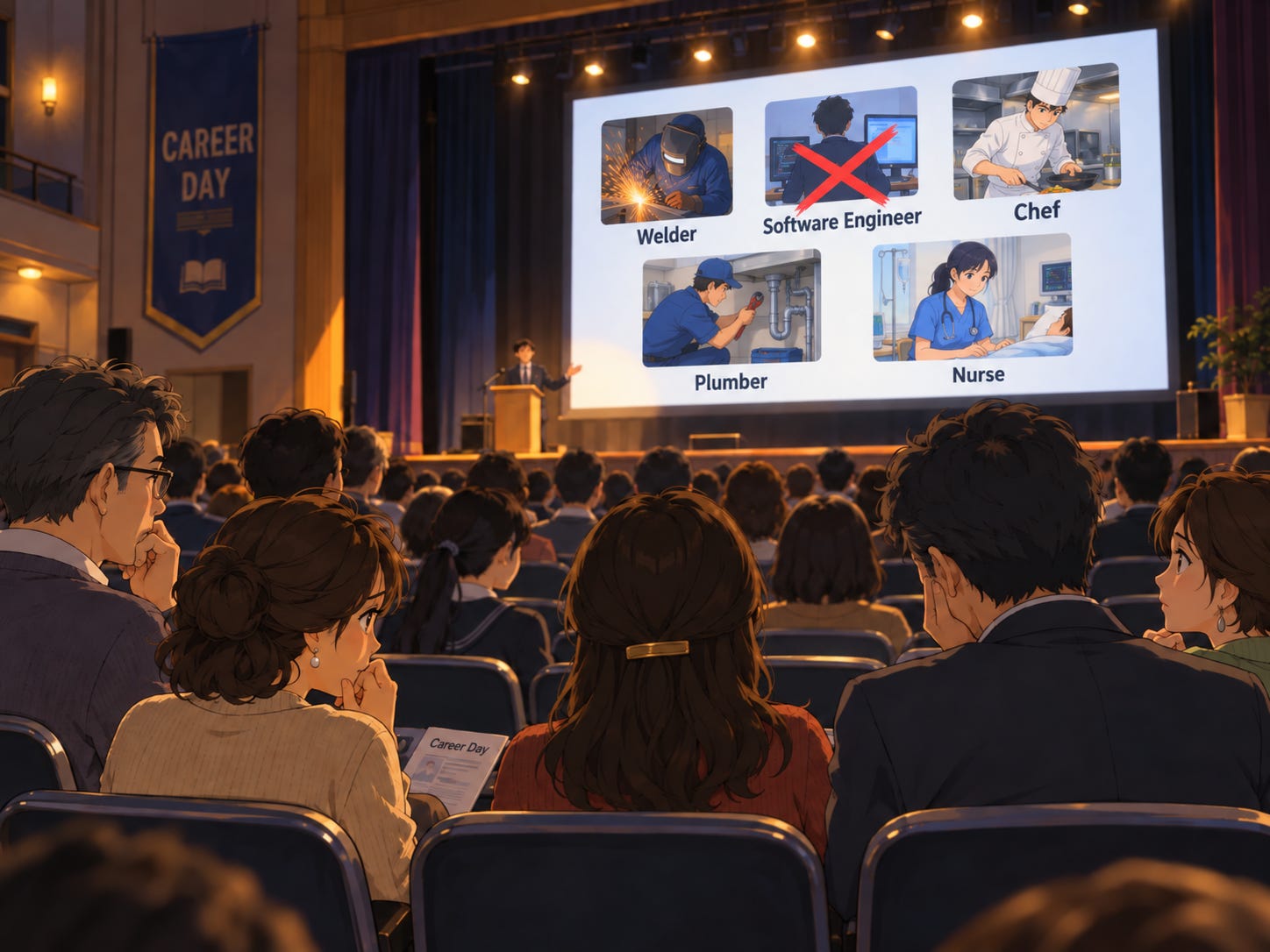
Last month, at a career presentation in my kids’ high school auditorium, an academic counselor walked through so-called AI-resistant jobs. Writing wasn’t on the list. Neither were bookkeeping or sales. Neither was computer science, which had been front and center every year before. I wanted to question it in front of the room, but I didn’t want to embarrass my kids. When I asked her about it, she went with what she knew. I told her what I think is coming: demand for people who can build with these tools is going to be so high that companies will hire people who aren’t ready, the same way any kid who knew HTML and Perl could get hired in the late ‘90s.
Sooner or later, AI is going to touch every field, directly or indirectly. If the label tells kids every one of those fields is doomed, they’ll talk themselves out of the work before they ever try it. Mine noticed. They’ve asked me whether I still love what I do. I told them yes. Even more now. It’s why I started this newsletter in the first place.
So don’t pick a side. Figure out where each idea comes from. Ask who’s saying it and what they’re actually afraid of. And keep politics out of it, even by association. Every CEO in this piece has had to work with whoever sits in the White House, whether they like it or not. A photo op doesn’t tell you what someone thinks about AI.
When we pick sides, we stop playing our game and start playing the media’s. Remember when the internet was supposed to kill print? Print shrank, and it changed. It didn’t die. But the media isn’t the enemy either. It’s a tool, like the one I write with, and a powerful one. Don’t underestimate it. Some outlets fan the flames. Others are doing the slow work of understanding this, and More Perfect Union and Germany’s DW are two I’d point you to. The least we can do is assume good faith from the ones who’ve earned it, so the real conversation can happen.
I started this piece with the rule I give my kids: attack the behavior, not the person. It turns out that’s also the only way to fix anything here. You can’t regulate a team. You can enforce a liability law. You can’t argue with a label. You can ask a data center builder to show up at the town meeting before the concrete goes in.
Every good model I use ends a hard question the same way, with a blank marked “Other.” It’s waiting on a human. It always will be, and honestly, it’s best that way.
Sources
The statement and the labs
Center for AI Safety: Statement on AI Risk press release (May 30, 2023)
Fortune, David Meyer: “Sam Altman has signed a new open letter on A.I.’s dangers” (May 30, 2023)
IT Brew: AI CEOs sign statement warning of “risk of extinction”
Marginal Revolution, Alex Tabarrok: “What Regulatory Capture Actually Looks Like” (September 2026)
Jensen Huang
36Kr: full transcript of CBS News interview with Jo Ling Kent (aired September 20, 2026)
The New York Times, The Ezra Klein Show: interview with Jensen Huang (September 23, 2026)
Media and the Gen Z conversation
More Perfect Union: “Bernie Sanders VS. 15 Gen Z On AI Use” (August 30, 2026)
TechCrunch, Sarah Perez: “Bernie Sanders’ AI ‘gotcha’ video flops” (March 23, 2026)
The money
The thermometer salesmen
Stanford HAI: AI detectors biased against non-native English writers (May 2023)
Vibe Graveyard: Adelphi ruling overturns Turnitin “100% AI” finding
Pasquale Pillitteri: universities ban AI detector scores; the Pangram conflict
AI Weekly: writers call Substack’s Pangram detector a witch hunt
Strip the context
Jobs, government, and labor
Radical Insider: “The AI Came for the Department. The Boss Left Instead.”
The Register: New Jersey seeks COBOL volunteers (April 5, 2020)
Northeastern CSSH / Startup Fortune: SignalFire 2026 data on junior hiring
The environment
The critic worth arguing with
MIT News: “What’s the right path for AI?” Karen Hao and Paola Ricaurte (March 20, 2026)
Pluralistic, Cory Doctorow: “What kind of bubble is AI?” (December 19, 2023)
WAMC: Cory Doctorow on The Reverse Centaur’s Guide to Life After AI (June 24, 2026)
Mr. Wonderful and the data center fights
KSL: Utah senator, Fox News apologize for linking data center foes to China
Media Matters: right-wing media fracturing over data centers
Al Jazeera: OpenAI says China-based actors stoking opposition to data centers
Axios Salt Lake City: How data centers drove Utah’s primaries (June 25, 2026)
Podcast Rex: Breaking Points, June 30, 2026 (Utah primary, O’Leary)
How this was made: I researched and drafted this piece with Claude, Anthropic’s model. Yes, the same Anthropic whose CEO signed those twenty-two words and whose safety test produced the blackmail headlines. Weigh that however you like. The facts are checked against the sources above, and every judgment call in here is mine. That’s the whole point.
Data note: Nvidia’s efficiency figures are company claims and have not been independently verified. OpenAI’s debt and commitment figures come from reporting on its financial statements, not audited public filings. Emissions comparisons use Nvidia’s own disclosures and a shareholder proposal in its FY2026 annual report.